

3-Roll Plate Bending/Rolling Machine: Working Principle & the Rolling Process

A 3-roll plate bending machine bends flat steel by squeezing it between three rolls: one on top, two underneath. The top roll presses down, the two bottom rolls turn the plate back and forth, and the plate slowly takes a curve. Move the rolls closer or farther apart and you change how tight that curve is, anywhere from a gentle arc to a full cylinder or a cone.
Ever wondered how the metal around you is getting its shape? Be it an automobile part, a ship, or a large metal container. It's not magic, but a machine breathing life into metal and turning it into breathtaking art.
Plate rolling is an incredibly essential part of any metal industry. The task of these rolling machines is simple: shaping metal plates into cones, cylinders, and curved shapes.
The definition looks simple, but the plate bending/rolling machines deliver sophisticated, cutting-edge, unique products. Different types of plate rolling/bending machines are available in the market. This blog will have a detailed view of a 3-roll plate rolling/ bending machine's working principle and rolling process.
We've been building these machines at Himalaya for more than 40 years. Over 2,500 installed and 400-plus repeat orders. So most of what's below comes off the shop floor, not out of a textbook.
What is a Plate Bending/Rolling Machine?
A Plate Rolling machine, also known as a roller machine, is a metal rolling equipment. Its main purpose is to shape metals into conical, cylindrical, or curved shapes. Industries worldwide require different machines according to their needs.
Plate rolling is a complex process but crucial for expanding the bending options available to your customers. Moreover, it depends on the precision levels and skill set of operators.
What Are the Types of Roll Plate Bending Machines?
There are three types of plate rolling/bending machines that individual industries need:
2-roll Plate Bending/Rolling machine
3-roll Plate Bending/Rolling machine
4-roll Plate Bending/Rolling machine
As mentioned above, each machine has its individual use, but here we will have a look at the 3-roll Plate Bending/Rolling machine.
What is the Working Principle of a 3-Roll Plate Rolling/Bending Machine?
Before understanding the working, let's have a brief look at a 3-Roll Plate Rolling/Bending Machine.
Industries of all sizes, from shipping to metal fabrication, need 3-roll plate bending/rolling machines. The process/task of the machine remains the same: bending metal sheets into the desired shape.
A 3-roll bending machine has three rolls: two side rolls that move back and forth, while the upper roll stays fixed but rotates. You can interchange this upper roll to fit shells of varying sizes.

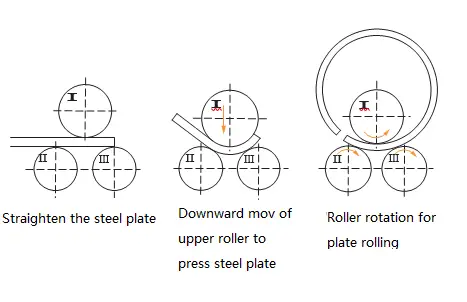
Images 1, 2, and 3 show how a 3-roll plate bending machine uses rollers A, B, and C to shape metal plates. This is a pre-pinching/pre-bending process in plate bending.
The manufacturer can control the amount and speed of the rollers to achieve the desired shape. As you can see, the plate smoothly and uniformly bends/rolls using the three rollers. The engineer can also bend or roll the desired location to achieve the required shape during the pre-bending process.
Let’s have a look at the mechanism in detailed steps.
Step 1: Placing the Plate
The first step for rolling a plate is placing the plate between the upper (I) and lower rollers (II and III). This process bends the plate into an arc or closed circle. As the metal sheet passes through the three cutting points created by the rollers, the plate will mold into the desired shape.
(Have a look at Diagram 1 of the working principle of a 3-roll rotating/ bending machine.)
Step 2: Plastic Bending Deformation
After the insertion of the metal plate, the top roller applies downward pressure on the plate. As a result, the plate undergoes a plastic bending deformation process due to compression.
Plastic bending deformation of metals occurs when an object's shape and size change due to applied force. Deformation happens when the shape of a material or object changes due to pressure. Plastic deformation occurs when the applied force is enough to cause a permanent deformation.
Step 3: Rotation & Friction
Due to the friction between the rollers and the plates, the lower rollers begin rotating, causing the plate to move back and forth along its longitudinal direction.
The plate moves back and forth as the lower roller alternatively does a forward and reverse rotation. At the same time, the upper roller continuously exerts vertical pressure or downward pressure on the plate.
The stress will exceed the yield limit during this process. Now the plastic deformation will occur. You can see the plate going through a plastic bending deformation. This entire process lets the plate take the required shape.
What the Diagram Won't Tell You: Yield Strength, Radius & Springback
The thickness number on a machine assumes mild steel, somewhere around 250 N/mm² yield, your IS 2062 E250 or EN 10025 S275 range. Roll something harder, say 350 N/mm², and the safe thickness drops, because the rolls have to push a lot harder to get past the higher yield point. So read the capacity chart against the grade you're actually running, not just the number on the spec sheet.
Next, you can't roll tighter than your top roll. The smallest radius you'll get is set by the upper roll's diameter. That's physics, not a setting.
And every plate fights back. The second you let the pressure off, the steel springs open a little and the radius widens. So we over-bend on purpose to land on target, and we over-bend more on thick or high-yield plate, because it springs back harder.
"We rate every machine at 26 kg per mm², about 255 N/mm². The mistake I see most is a fella reading the thickness number and ignoring the grade. Roll harder plate on a mild-steel chart and you'll cook the rolls." Rashmi C Shah, Co-Founder, Himalaya Machinery
Key Factors of a 3-Roll Plate Bending/ Rolling Machine
To bend the plate to a radius no longer than the upper roller, you can modify the relative position of the upper and lower rollers.
A motor and a reducer power the lower roller (II and III), making them rotate in a similar momentum and the same or opposite direction.
To vary the curvature of the desired plates, you can adjust the position of the upper rollers.
You can change the position of the upper rollers to vary the curvature of the desired plates. Moreover, you can readjust the upper roller if you do not receive the desired curvature after a single rolling process. Then, you can redo the process until you achieve the desired shape.
There is one disadvantage of this machine. When you look at the above diagram, you can notice that the three rolls of the 3-roll bending/rotating machine form an isosceles triangle.
During the process, this triangle-forming shape forces the two ends of the machine to leave a straight part. The straight part of the machine is half the distance between the centers of the two lower rollers. This is the part where the rollers cannot roll.
Despite this one disadvantage, there are several benefits and features of a 3-roll plate bending machine. The main benefits of this plate rolling machine are structure, ease of operation, and low cost.
What Is Pre-Pinching in Plate Rolling (and Why It Decides Your Seam)?
When a flat plate first goes in, the front edge is dead straight and the rolls can't grab the very tip. Leave it like that and you get a flat, unbent tongue at both ends of the cylinder, and a rough seam to weld.
Pre-pinching is how you beat it. You clamp the leading edge between the top roll and one bottom roll and bend that flat end first, before the main pass. Then you flip the plate and do the trailing edge the same way.
Get this right and the seam closes clean. Get it wrong and you're grinding flats off the ends for the rest of the shift. On a symmetrical 3-roll machine that leftover flat runs about half the distance between the two bottom rolls. That's exactly the bit pre-pinching is there to shrink.
"On a 3-roll, most of your finished quality is decided before the main pass, in how clean you pre-pinch both edges." Rashmi C Shah, Co-Founder, Himalaya Machinery
How to Roll a Plate on a 3-Roll Machine: Step-by-Step
Here's the order we'd run a plate on the floor.
Check the plate against the chart. Thickness, width, and grade. Say 12 mm IS 2062 E250. Read it against the machine's capacity at that grade, not just the thickness.
Square it and mark it. Square the plate, mark your rolling direction, and build a bit of springback into your target radius.
Pre-pinch both ends. Bend the front edge, flip the plate, bend the back edge.
Make a gentle first pass. Bring the top roll down for a radius bigger than your target and run the whole plate through once.
Close in stages. Drop the top roll a touch each pass and let the bottom rolls feed the plate both ways. Don't try to get there in one bite.
Check it against a template. Measure the curve, allow for springback, run it again if it's still open.
Bring the ends together and tack. Check the gap at the seam first, then tack for welding.
Re-round after welding. One light pass takes out any flat at the weld and trues the shell.
The rule that saves the most scrap: lots of light passes beat a few heavy ones. Rounder shell, fewer surprises, and a lot easier on the bearings.
Cone Rolling and Crowning: The Details That Save Scrap
How to Roll a Cone on a 3-Roll Machine
Rolling a cone is a different animal. The big end of the plate has to travel faster than the small end, so you set the rolls and side guides to let the plate swing around the cone's point instead of feeding straight through. It's slower and it takes a feel for it. This is where an experienced operator earns his keep.
Why the Rolls Are Crowned
Long rolls sag a little in the middle under load, which would leave you a barrel or hourglass shape on a wide plate. So the rolls are ground with a slight bulge in the middle, called a crown, that flexes back to straight under pressure. The plate comes out a true cylinder edge to edge, not just at the ends.
3-Roll Plate Rolling Capacity (K-Series)
Our K-Series three-roll machines roll plate from 10 mm right up to 160 mm, in 2500 mm and 3000 mm widths. Every capacity on the chart is rated at 26 kg/mm² yield, about 255 N/mm², so a harder grade will roll thinner than the number shown. The rolls are crowned to hold a true cylinder across the full width, and cone bending is built in as standard.
Model | Width (mm) | Top roll (mm) | Rolling capacity (mm) | Pre-pinching (mm) |
KCH/25 | 2500 | 230 | 13 | 10 |
KKH/25 | 2500 | 430 | 40 | 35 |
PPH/25 | 2500 | 640 | 85 | 60 |
KCH/30 | 3000 | 230 | 10 | 6.5 |
KKH/30 | 3000 | 430 | 37 | 31 |
PPH/30 | 3000 | 640 | 80 | 58 |
PUH/30 | 3000 | 900 | 160 | on request |
All dimensions in mm. Capacities rated at 26 kg/mm² (about 255 N/mm²) plate yield strength. Himalaya Machinery K-Series data. The full 24-model range is on our Three Roll Plate Bending Machines page.
A note on grades: in India, mild-steel plate follows IS 2062 (E250 means 250 N/mm² yield); in Europe the same steel sits under EN 10025. Pressure-vessel shells get rolled to the tolerances in ASME Section VIII, Division 1.
Wrapping Up!
3-roll plate bending machines have played an important role in history and continue to do so. You can rely on our plate-bending machines across various industries, including shipping, oil tanks, metal structures, tubes, and pipes. Be it 2-roll bending, 3-roll bending, or 4-roll bending machines.
We hope this blog helped you understand the working principle of our 3-roll bending machine. Feel free to contact us for all your plate-bending machinery needs. Our team at Himalaya Machinery would love to help you.
3-Roll Plate Bending Machine FAQs
How does a 3-roll plate bending machine work?
It squeezes flat steel between one top roll and two bottom rolls. The top roll presses down, the bottom rolls turn the plate back and forth, and where the bending force passes the steel's yield strength, the plate takes a permanent curve. Change the roll gap and you change the radius.
What is pre-bending (pre-pinching) in plate rolling?
It's bending the flat front and back edges of the plate before the main rolling pass, by clamping each end between the top and a bottom roll. It gets rid of the straight, unbent flat at the ends so the seam closes clean.
What plate thickness can a 3-roll machine handle?
Depends on the roll size, the drive, and the plate grade. Capacity is rated for mild steel at 26 kg/mm² (about 255 N/mm²); harder plate brings the safe thickness down. Himalaya's K-Series 3-roll machines roll from 10 mm up to 160 mm, in 2500 mm and 3000 mm widths.
What's the tightest radius a 3-roll machine can roll?
No tighter than the top roll's diameter. That's the hard limit.
Why does the plate spring back after rolling?
Steel relaxes when you release the pressure, so the radius opens up a little. You bend past the target to make up for it, more so on thick or high-yield plate.
Symmetrical vs asymmetrical 3-roll machine: what's the difference?
On a symmetrical machine the top roll sits centered over the two bottom rolls, which leaves a bigger flat to pre-bend at both ends. An asymmetrical machine offsets the rolls so you can pre-bend one end more easily and leave less flat.
Is having 4 rollers in parallel multi-stage rolling?
No. A 4-roll machine is still single-stage. It just adds a fourth roll to grip and pre-bend the plate in one setup. Multi-stage rolling means running the metal through several separate roll stands one after another, which is a different process.
Which industries use 3-roll plate bending machines?
Shipbuilding, pressure vessels, oil and gas tanks, wind towers, silos, tubes and pipes, and general heavy fabrication. Basically anywhere a flat plate needs to become a cylinder, a cone, or an arc.


Comments